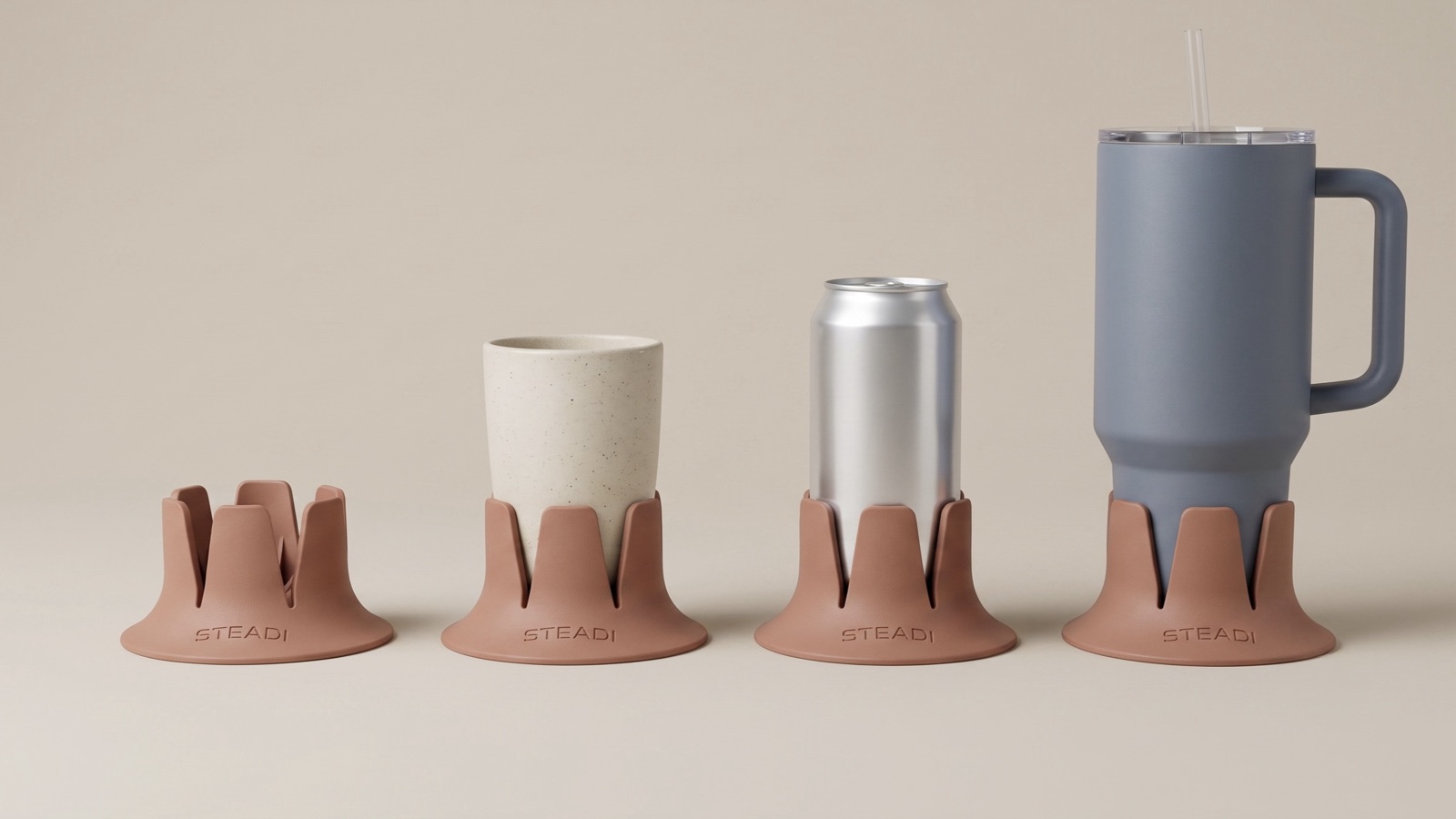
Finally, somewhere to put your drink on the outdoor couch.
A flexible base that holds your wine, seltzer, or tumbler steady on the cushion, the wicker arm, or the deck boards beneath the couch — for the golden-hour glass that never quite makes it to the coffee table, and the fire-pit circle that never had a table to begin with.
One flexible base. Empty on the wicker arm, then a can, a wine glass, and the 40 oz tumbler that outlasts the whole evening outside.
The situation
The deeper the seat, the farther the table.
Deep seating is built for leaning back, not for reaching forward — so the low table across the conversation set stays a genuine forward fold away, no matter how many times you want it. The drink ends up wherever a hand lands instead: the cushion, the wicker arm, the gap beside you.
The cushion beside you.
Outdoor lounge cushions run four to six inches thick and slightly domed, so nothing narrow sits level on them for long. A can set down on the cushion rides the crown, leans off it, and goes over the first time the person next to you shifts their weight.
The wicker armrest.
All-weather wicker is resin woven over an aluminum frame, and the arm on top is usually rounded rather than flat — a ridge to balance a drink on, not a shelf. Morning dew and evening condensation collect right where a base would need to grip.
The gap between the cushions.
It looks like a built-in slot, snug on both sides. But the seat cushions here mostly just rest on strap or sling bases, so the gap opens and closes with every person who sits down or gets up — the fit that held a can a minute ago is gone the moment a seatmate stands.
The fire table, if you can reach it.
Chat-height fire pit tables sit lower than a dining table on purpose, for lounging — which puts the one shared ledge in the circle below everyone's reach, crowded, and right next to open flame. Forum threads about fire pit seating keep circling back to the same unanswered question: where does the drink actually go?
The deck boards, or the grass past the patio.
Step off the cushion and the ground isn't flat either — deck boards are laid with drainage gaps, and paver patios are graded to shed rain away from the house. Once a crowd spills onto the lawn for the fire pit, it's root-lumpy turf that swallows a can at ankle height, invisible the second the sun's down.
It isn't a nightly failure so much as a nightly negotiation — cushion, arm, gap, table, grass — one the couch runs fresh every evening it fills up, and a seat this deep turns each option into a reach too far.
You know the moment
The backyard runs through the same five evenings all summer.
Golden hour, right after dinner
You've finally nested cross-legged into the deep seat with a glass of wine, blanket over your knees, string lights just coming on — and the coffee table is a full un-nest and lean away. The glass goes down on the cushion by your knee, upright for exactly as long as nobody else sits down.
Fire pit night, after dark
Chairs and the sofa pulled into a circle around the flames means no table made the circle either. Every can ends up standing in the grass by a chair leg, invisible in the dark, until the dog's lap around the pit finds one.
The gust ahead of the storm
The sky goes gray fast, one gust arrives before the rain — napkins first, then the light aluminum side table someone dragged over goes down with the seltzer still on it. That's tonight's search: how to keep patio furniture from blowing away.
Cookout, plates just off the grill
Every lap gets a burger, so every drink gets parked wherever a hand is free — on the wicker arm's crown, wedged in the cushion gap, on the deck between two feet. The first shift toward the ketchup sends a can sliding into the valley between cushions.
Slim-can hour, digging for sunscreen
A hard seltzer — six inches tall on a base barely over two — gets stood up on the springy cushion while both hands go looking through the bag. It's the tippiest can on the patio, set on the tippiest seat on the patio.
What you get
Three reasons it stays out.
01
Steady on the dome, not just the flat
The wide flexible base spreads across a domed cushion or a crowned wicker arm instead of balancing on the high point. Shift your weight, stand up, sit back down — the base flexes with whatever's underneath it and the drink settles back level.
02
Holds what actually comes out to the couch
The sweating can, the stemless wine glass, the seltzer, the 40 oz tumbler. Cans and bottles slide on; cups, glasses, and tumblers drop in through the fins and get gripped by the bottom inch, condensation and all.
03
Built to live outside
One piece of injection-molded flexible material — no metal to rust, no mesh to sag, no fabric to hold a stain. Rain doesn't bother it, the hose cleans it, and it moves from the cushion to the wicker arm to the fire table in one hand.
The fit test
The fit test rides out to the patio with you.
your cup's base lands in here
A square sticky note: 3 inches, exactly.
01
Grab a sticky note.
The classic square measures exactly 3 inches on a side. That's a fact about sticky notes — and it happens to be the exact ceiling of what fits.
02
Stand tonight's drink on it, out on the patio.
The wine glass, the seltzer can, whatever's actually heading outside with you. Look at the bottom, not the rim — a stemless glass bows out and a seltzer can tapers, so the base is the only measurement that counts.
03
Read the note.
Base sits inside the square? It fits. Hangs over the edge? Too wide. A tiny circle lost in the middle — under about 2 inches? Too narrow.
No tape measure at the patio table, no guessing before the fire's lit — one sticky note from the kitchen drawer, and the glass you actually brought outside.
Will it fit my cup
Measure the bottom, not the top.
One rule covers everything below: a container base about 2 to 3 inches across settles in.
Standard 12 oz can fits
Sleek hard-seltzer can fits
40 oz Stanley-style tumbler fits
Stemless wine glass fits
20-30 oz insulated tumbler fits
Glass beer bottle fits
Red plastic party cup fits
Can in a foam koozie too wide
Coffee mug, handled handle in the way
Shot glass too narrow
There's a floor as well as a ceiling — under about 2 inches, a base sits too loose to grip. A foam koozie is the one everyday case that pushes a can's base past the top of the range instead of inside it. And the handled mug is the honest exception: the base fits, the handle just lands exactly where a fin needs to close.
How it works
Three parts, no moving parts.
The base spreads out.
A can set on a domed cushion or a crowned wicker arm touches it at one high point. The wide flexible base lays flat across the curve instead of teetering on top of it.
The fins grip.
Flexible fins hold the drink by its bottom inch — a grip that doesn't care that the can is sweating, the glass is slick with condensation, or the seltzer is standing six inches tall on a narrow base.
It settles.
Someone drops onto the cushion next to you, the gap between seats opens back up as they stand, a gust moves through — the base flexes with the surface underneath it and brings the drink back level.
Nothing wedges into the cushion gap. No clamp sized to one width of wicker arm, no wedge that needs the cushions a certain distance apart, no spike that needs lawn to stab into. It sits on the cushion, the arm, the gap, or the deck itself, and it moves to the fire table in one hand when the circle re-forms.
The backyard living room
Every surface out here was engineered for weather, not for drinks.
None of this is neglect — the cushions are engineered to shed rain, the wicker is engineered to survive weather, the pavers are graded to drain. Every feature that keeps the furniture outside works against a set-down drink exactly the same way it works for the furniture.
The lounge cushion
Covers are solution-dyed acrylic — Sunbrella-class, hydrophobic on purpose, so a spill beads and sheets sideways instead of sitting still. The fill underneath is reticulated open-cell foam, engineered so rain drains straight through it — which means a spill drains straight into it too, and the sugar in it lingers in the foam core.
The resin-wicker armrest
All-weather wicker is resin woven over an aluminum frame, with arm tops crowned or rounded rather than flat. Clip-on trays and holders admit as much on their own listings: built for flat arms of a minimum thickness, and a curved or oversized arm isn't one of them.
The gap between cushions
Seat cushions here mostly just rest on strap or sling bases, held by a few fabric tabs — so the valley between them widens and narrows with every person who sits or stands. A can wedged snug a minute ago is loose the moment the seat beside it empties.
Deck boards and paver patios
Boards are laid with drainage gaps of roughly an eighth to a quarter inch, and pavers are graded away from the house for runoff — about a quarter inch of pitch per foot. The floor under the couch is gapped and quietly sloped, never actually level.
The lawn past the patio
Spongy, root-lumpy, and never flat at the scale of a can's base — and it's exactly where seating overflows on cookout and fire-pit nights. A can balances on turf, not ground, and disappears from view the moment the sun's down.
The chat-height fire table
Built low on purpose, for lounging — about 22 to 25 inches versus 28 to 30 for a dining table — which puts the one ledge everyone shares below easy reach and right next to open flame.
Versus what you do now
The patio aisle has already tried to fix this.
The clip-on bamboo arm tray
The default Amazon answer for a couch-arm drink, and it's built for flat indoor furniture — sellers themselves warn it doesn't suit oversized, curved, or low armrests, and reviewers report a rounded arm makes the tray wobblier than no tray at all. Bamboo is an indoor material to start with; the anti-warp construction some brands advertise as a feature is really an admission of the outdoor failure mode.
Ground drink-holder stakes
They only work where there's soil to stab into, which rules out the deck and the pavers where the couch actually sits. Where they do work, they park the drink at ankle height an arm's reach from the seat, and moving the furniture means pulling and re-planting every stake.
Clip-on or slide-on chair-arm cup holders
Fit is a lottery: makers publish minimum arm-thickness requirements and acknowledge their own holders won't clamp onto some of their own furniture lines. Woven, tapered, and rounded arms — exactly what an outdoor couch has — are exactly the arms they can't grip.
A side table for every seat
The light folding ones are the ones that go over — even a reviewer who liked one conceded an afternoon storm would flip it — while the heavy, wind-resistant versions cost real money, crowd a conversation-set layout built for open sightlines, and still rock on pavers pitched for drainage instead of level.
Before you buy
Questions people actually ask.
Does it actually work on outdoor lounge cushions?
That's the surface it's shaped for. Cushions here run four to six inches thick and slightly domed, so the wide flexible base spreads across the crown instead of balancing on top of it, and the fins keep the drink from rattling loose as the cushion re-shapes under you. It resists tipping — nothing bolts down.
What about the resin-wicker armrest?
Same idea. A crowned or rounded arm gives most add-on trays nothing flat to grip — this doesn't need flat. The base spans the curve, and the fins hold the drink by the bottom inch, condensation and all.
Will the wind take it?
Wind gets under light, tall things — that's why the folding side table goes over in a gust. A drink gripped low and wide by its bottom inch gives a storm far less to work with than a bare glass standing alone. It resists tipping; a real gale is still a real gale, so when the umbrella comes down, bring the drinks in with it.
Is it OK to leave out on the patio all season?
Yes. It's one piece of injection-molded flexible material — no metal to rust, no mesh to sag, nothing for weather to break down. Rain doesn't bother it; hose it off along with the cushions, or run it through the dishwasher after a sticky night.
Will my stemless wine glass or my tumbler fit?
Check the base, not the rim. A container base about 2 to 3 inches across settles in — the 40 oz Stanley fits, and so does a stemless wine glass. Handled mugs don't; the handle lands right where a fin needs to grip.
Does it clamp onto the wicker frame or the cushions?
No clamps, no wedges, no stakes, no adhesive. It sits on top of whatever the evening offers — cushion, arm, the gap between seats, the fire table — and moves with you when the circle re-forms around the flames.
The gap between our cushions changes size depending on who's sitting where. Does that matter?
Not to this. A wedge sized to one gap width stops working the moment somebody stands up; a base that simply sits on top of a cushion or in the gap doesn't care how wide it is that minute.
We end up out on the grass past the patio on fire pit nights — does it work there too?
Yes — soft, uneven, moving ground is what this shape was built around. It spreads across turf the same way it spreads across a cushion, instead of balancing on one root or one lump.
Will a spill draw ants or wasps?
A sugary spill left in a cushion or between deck boards is exactly what draws them — the outdoor version of a problem indoor couches don't have. Holding the drink steady in the first place is the fix; there's nothing left behind to soak in or attract anything.
How do I clean it?
Rinse it or run it through the dishwasher. It's one piece of flexible material with nothing to unscrew or come apart, even after a night of sunscreen and s'mores hands.
Who makes it, and where do I buy one?
It's called the Steadi, molded in small runs in Orange, California by Steadi Labs. Every order ships free from steadilabs.com, with 30 days to change your mind.
Who makes it
Made start to finish in Orange, California.
The maker is Steadi Labs, a small veteran-founded company in Orange, California. It's injection molded — the mold, the material, and the color runs all sit within about three and a half miles of the shop, and every batch is molded there in small runs. The people who make it are the same people who answer hello@steadilabs.com.
Thirty days, wherever you use it.
Use it for a month. If it doesn't do what this page says, email hello@steadilabs.com and it gets made right — no forms, no fight.
Veteran-founded · Patent pending · Made in Orange, California
Stop reaching for the table.
The can stands steady on the wicker arm, the wine glass rides the cushion beside you — and nothing's left standing in the grass, invisible, when the circle breaks up for the night.